How AI Software Development is Transforming Enterprises in 2026
A deep-dive into the intelligent automation, predictive analytics, and personalization systems reshaping how modern businesses compete and grow.

By 2026, artificial intelligence is no longer a research technology confined to innovation labs. AI has become an integral component of software development, fundamentally changing how businesses operate and compete on an entirely new digital platform of efficiency and intelligence.
Businesses across manufacturing, finance, healthcare, retail, logistics, and SaaS are increasingly embedding AI within their software infrastructure to address critical business challenges. The uniqueness of 2026 lies not just in access to better AI models, but in mature, production-ready architectures for deploying AI at enterprise scale.
Understanding AI Software Development in the Enterprise Context
AI software development means designing, building, deploying, and maintaining applications that learn, reason, predict, or make decisions. In enterprise terms, this encompasses far more than chatbots or basic automation.
It includes:
- Machine learning models for predictions and recommendations
- Natural language processing for understanding text and speech
- Computer vision to interpret images and video
- Intelligent automation and robotic process automation
- Generative AI for content, code, and strategic insights
Enterprise-grade AI software is scalable, secure, compliant, and deeply integrated with business workflows. That is why AI in enterprise software has become a strategic investment rather than a tactical experiment.
Why 2026 is a Turning Point
Several factors have converged to make 2026 a landmark year for AI-driven transformation:
Maturity of AI models. Modern models are more accurate, explainable, and adaptable than ever. Enterprises now trust AI systems to support high-stakes decisions.
Cloud-native and hybrid architectures. AI development now supports hybrid and multi-cloud environments, making deployment flexible and cost-effective.
Enterprise data readiness. Significant investment in data engineering, governance, and analytics has enabled AI systems to deliver meaningful insights.
Responsible AI frameworks. Ethics, data privacy, and regulatory compliance are now embedded into enterprise AI development from day one.
Key Ways AI is Reshaping Enterprise Operations
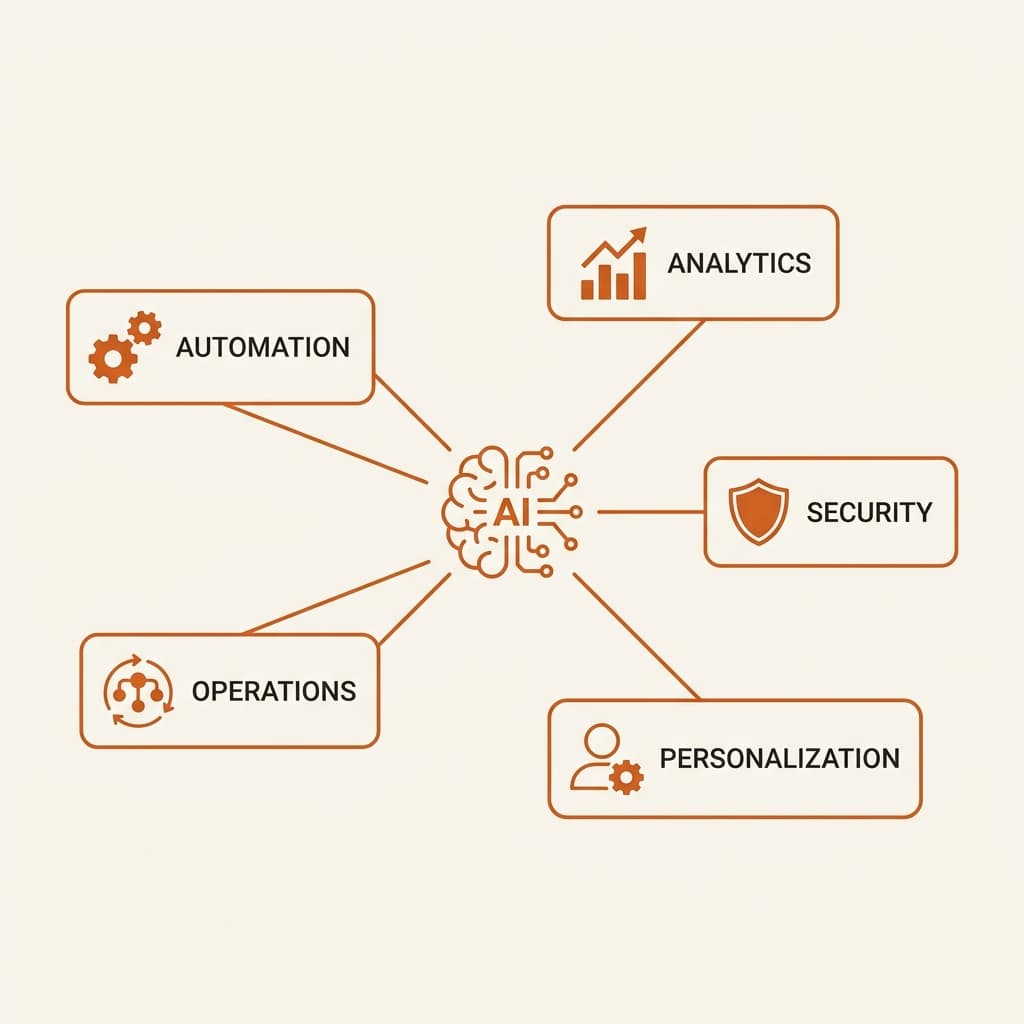
1. Intelligent Automation
Unlike traditional automation, AI-powered systems adapt, evolve, and improve by learning. Examples include:
- Automating invoice processing using NLP and ML
- AI-powered customer service systems handling inquiries autonomously
- Intelligent workflow management across departments
This cuts costs, eliminates errors, and frees staff to focus on high-level strategic work.
2. Predictive Analytics and Smarter Decisions
Enterprises have shifted from reviewing past results to looking ahead before taking action. AI enables:
- Demand forecasting in supply chains
- Predictive maintenance in manufacturing
- Risk analysis in finance and insurance
- Customer churn prediction in SaaS and telecom
By combining business intelligence with AI, enterprises gain real-time insights that drive proactive decision-making rather than reactive firefighting.
3. Personalized Customer Experiences at Scale
In 2026, personalization is not optional. AI allows enterprises to deliver highly customized experiences across every digital touchpoint:
- AI-driven recommendation engines
- Dynamic pricing models
- Targeted marketing campaigns
- Advanced CRM systems that forecast customer needs
This level of personalization enhances satisfaction, retention, and lifetime value.
4. Cross-Departmental Transformation
AI is not restricted to IT. It is transforming every function:
| Department | AI Application | |-----------|---------------| | HR | Recruitment screening, staffing planning | | Finance | Automated forecasting, fraud analysis | | Sales | Lead scoring, revenue predictions | | Operations | Smart resource allocation, process optimization |
This holistic adoption is what defines genuine enterprise-wide AI integration.
5. Cybersecurity and Risk Management
With escalating cyber threats, enterprises are using AI for real-time protection:
- Anomaly detection in network traffic
- Predicting potential security breaches
- Automating incident response
- Enhancing identity and access management
AI has become an essential component of enterprise security strategy.
Real-World Enterprise AI Use Cases
Manufacturing: Predictive maintenance using sensor data, computer vision for quality inspection, AI-optimized production scheduling.
Healthcare: AI-assisted diagnostics, intelligent patient data management, predictive analytics for treatment outcomes.
Retail and E-commerce: Personalized shopping experiences, demand forecasting and inventory optimization, AI-powered visual search.
Finance and Banking: Fraud detection and risk scoring, algorithmic trading, automated compliance monitoring.
Logistics and Supply Chain: Route optimization, predictive demand planning, AI-powered warehouse automation.
Benefits for Enterprises
- Improved operational efficiency — AI automates repetitive tasks and optimizes workflows
- Data-driven growth — AI insights identify new opportunities and improve performance
- Competitive advantage — Early AI adopters gain agility and innovation leadership
- Scalability — AI systems scale with growth without proportional resource increases
- Improved customer interaction — AI-driven personalization increases brand loyalty
Challenges to Address
Data quality and integration. AI needs high-quality, properly structured information from various sources.
Talent and skill gaps. Developing and maintaining AI software requires specialized expertise.
Ethical considerations. Bias, transparency, and compliance remain major concerns that must be addressed proactively.
Legacy system integration. Many businesses still operate on infrastructure that makes AI deployment difficult.
Best Practices for AI Success
- Align AI initiatives with business goals. AI projects should solve real problems, not just showcase technology.
- Invest in data foundations. Strong data governance and engineering are prerequisites.
- Start small and scale strategically. Pilot projects validate use cases before full deployment.
- Prioritize responsible AI. Ensure transparency, fairness, and compliance throughout the lifecycle.
- Foster cross-functional collaboration. AI success requires alignment between IT, business, and leadership teams.
The Future Beyond 2026
Enterprise AI will continue evolving in several directions:
- Greater adoption of autonomous AI systems
- Deeper integration of generative AI into enterprise workflows
- Increased focus on explainable and trustworthy AI
- Expansion of AI-powered decision intelligence platforms
The future of AI development is aimed at creating businesses that are not only digitally transformed but intelligence-driven.
Organizations that treat AI as a core competence — not a means to an end — will lead their respective industries. The ones investing today are not just optimizing performance; they are future-proofing their entire operation in a competitive digital environment that evolves faster every quarter.