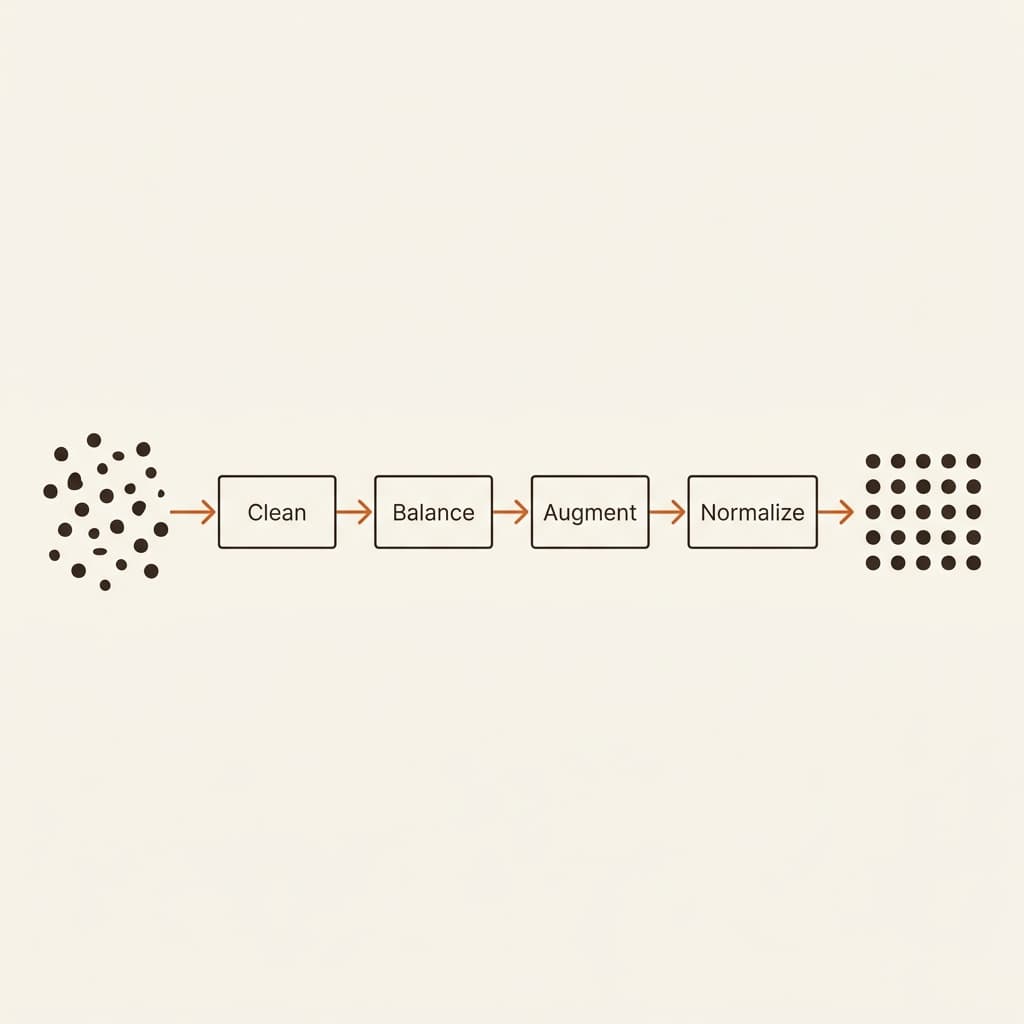
Dataset Optimization: Enhancing Machine Learning Performance Through Data
The complete playbook for cleaning, balancing, augmenting, and engineering datasets that produce accurate, unbiased, and efficient ML models.

To enhance machine learning performance, there are four key areas you must optimize: algorithms, compute, training practices, and data. Today, we focus on data.
If you ignore dataset optimization, there is a high likelihood of building biased or unfair machine learning models. This occurs when you feed models imbalanced datasets. Beyond unfairness, poor dataset optimization contributes to wasted compute resources because you are working with messy data. Such data increases storage needs, training time, and cost.
Here is how to optimize machine learning datasets to prevent these troubles and build models that actually deliver.
1. Data Cleaning: The Non-Negotiable First Step
Even if you obtain an off-the-shelf machine learning dataset, check for missing values, duplicate records, outliers, and incorrect formatting.
Missing values can confuse a learning model. If you are working with a small dataset, filling the gaps with reasonable estimates is acceptable. For massive datasets, use a predictive model to help generate estimates.
Duplicate records lead to bias because the machine learning model believes the duplicate entries have more importance. Use tools like Pandas or OpenRefine to eliminate them.
Outliers are values that do not fit the expected range. For example, an employee income record of $2,000,000 when incomes are supposed to range between $20,000 to $60,000. Be careful when assessing outliers — sometimes they result from incorrect entries, and not all outliers lack significance.
2. Data Balancing: Solving the Class Imbalance Problem
Picture this: You have a model that detects a particular disease. Out of 1,600 patient records, 1,500 are healthy patients while 100 represent the sick. The AI model will overwhelmingly predict records as "healthy," failing to achieve its core objective.
Solutions for imbalanced datasets:
- Oversampling the minority class. Use techniques like SMOTE (Synthetic Minority Oversampling Technique) to generate additional synthetic but realistic records.
- Undersampling the majority class. Reduce the dominant class to match the minority. However, you risk discarding crucial data.
- Hybrid approach. Combine both undersampling and oversampling to retain useful information while achieving balance.
- Algorithm-level adjustment. Modify the model to focus more on the minority class during learning.
3. Data Augmentation: Expanding Thin Datasets
There are times you want to train a model only to realize that the available datasets are thin. Collecting new data may not be possible due to tight resources or how specialized the problem is.
Augmentation is the process of expanding a dataset without collecting new data by modifying existing values to create unique examples.
For image data: Flip, crop, rotate, change brightness, or resize images.
For text data: Add synonyms, shuffle words, or randomly insert or delete text.
For audio/video data: Add background noise, shift timing, or stretch duration.
Advanced augmentation: Use LLMs to generate paraphrased sentences or employ simulators to create synthetic environments for data that would be dangerous or costly to collect in real life.
The goal is to provide the model with variety so it extracts relevant patterns rather than memorizing.
4. Feature Selection and Engineering
A feature is an individual measurable variable in a dataset — think of it as a column in a structured table. For a housing prices dataset, features include age of the house, square footage, number of bedrooms, and location.
Feature selection means identifying and keeping only the most relevant variables. If the housing dataset includes "color of the front door," this feature has minimal impact on pricing and should be removed.
Feature engineering means transforming existing features or creating new ones. Converting "date of birth" to "age" is a classic example that enhances model understanding.
Both techniques make models faster and more efficient because they learn only from meaningful features, boosting accuracy by focusing on patterns that actually matter.
5. Normalization and Standardization
Both are about rescaling numerical features, but they serve different purposes.
Normalization ensures feature values fall within a specific range (typically 0 to 1). You subtract the minimum value and divide by the range. This prevents any single feature from dominating simply because it has larger numerical values.
Standardization transforms data so the standard deviation becomes 1 and the mean becomes 0. You calculate the mean, then subtract it from each value and divide by the standard deviation.
Normalization is essential for algorithms that rely on distance calculations or clustering. Standardization is critical for algorithms like linear regression or logistic regression that assume centered and scaled data.
The Storage and Security Layer
Before feeding data into an AI model, optimize it through the techniques above. But remember to set up systems to efficiently and securely store and retrieve data. Without this, data could be exposed to cyberattacks, leaks, and unauthorized access.
If stored data gets tampered with, duplicated, or corrupted, it can ruin model performance regardless of how well you optimized the original dataset.
The Bottom Line
Dataset optimization is not optional — it is the foundation that determines whether your machine learning model will be accurate, fair, and efficient, or biased, wasteful, and unreliable.
The techniques are straightforward: clean, balance, augment, select features, and normalize. The discipline is in applying them consistently before every training run. The companies that treat data quality as a first-class engineering concern are the ones building models that actually work in production.