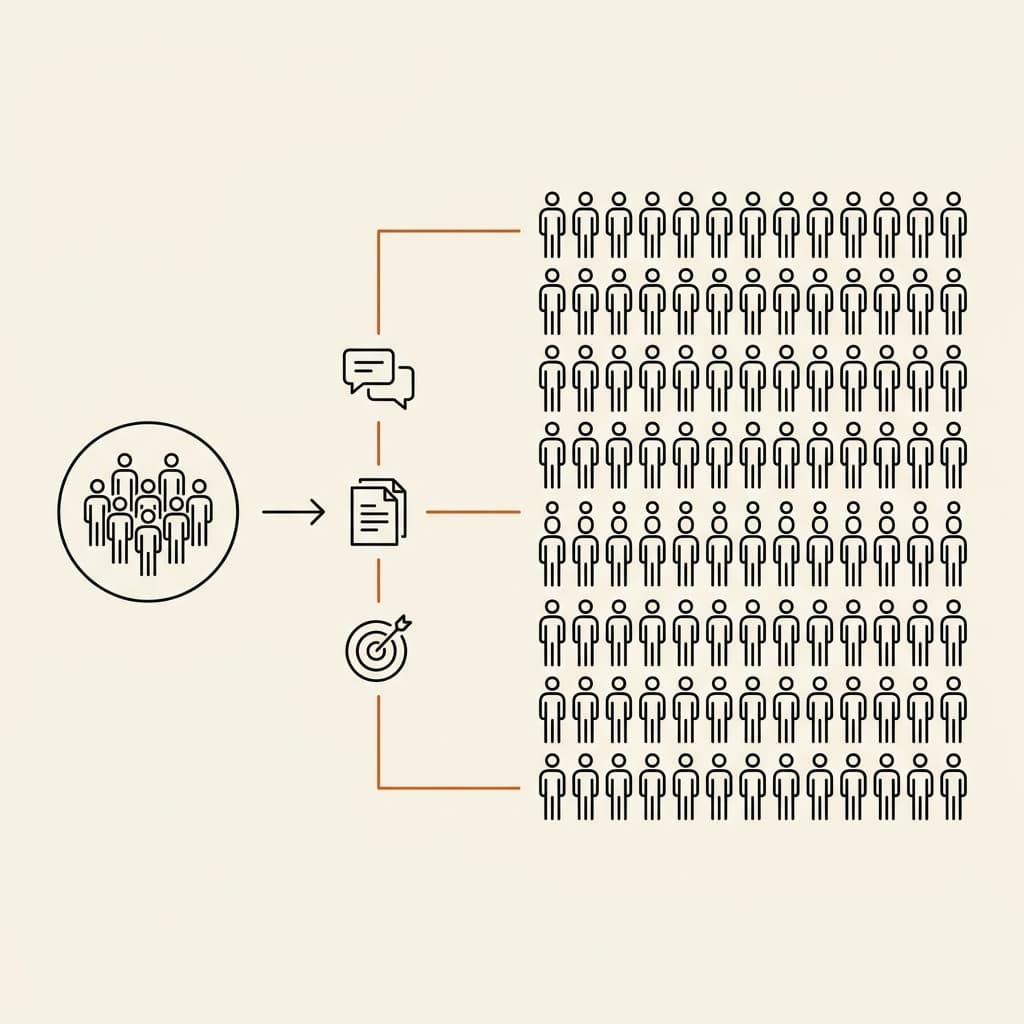
From 10 to 200 Employees: How to Keep Culture and Coordination Intact
The playbook for scaling your team without losing the clarity, speed, and identity that made your company worth joining in the first place.

The jump from a tight-knit team to a full organization is where most companies quietly lose something they can never quite name.
At ten people, culture is implicit. Everyone knows the priorities, the communication style, and who to call when something goes wrong. At two hundred, none of that travels on its own. The coordination habits that worked at small scale stop working, and the culture that made the company worth joining starts to feel like a memory.
The companies that navigate this transition well don't do it by adding more management layers. They do it by building infrastructure that carries culture and coordination forward as the team grows.
The Communication Shift: From Informal to Intentional
When a team is small, informal communication handles most coordination. A quick message in the group chat, a hallway conversation, a shared lunch where someone casually mentions a deadline. When that same team grows to fifty, then a hundred, then two hundred — informality creates noise rather than clarity.
The solution is not to kill informal communication. It is to layer structure on top of it.
What the best scaling companies do:
- Scheduled broadcast windows. Company-wide updates go out at consistent, predictable times. The entire organization receives the same information simultaneously rather than hearing it filtered through management layers at different speeds.
- Organized conversation architecture. Group chats and channels are labeled and structured to mirror the company's actual org chart. A new hire can immediately navigate to the right conversations without asking someone which channel to join.
- Read confirmation on critical messages. Leadership can confirm that time-sensitive messages have reached the people they were sent to, replacing the guesswork of hoping a broadcast was actually read.
- Cross-language accessibility. International team members participate in the same conversations on equal terms, so growth into new markets doesn't create two-tier communication.
The goal is not more communication. It is better-routed communication.
Institutional Memory: Decisions That Survive Growth
Growing companies lose institutional memory faster than they realize. A decision gets made in a meeting, the participants remember it differently a month later, and by the time it matters, the original reasoning is gone.
This is the silent killer of scaling companies. Not bad decisions — forgotten decisions.
The infrastructure fix:
- Standardized document templates. Project briefs, meeting agendas, and decision records follow consistent formats so that quality and structure don't depend on individual skill or memory.
- Full version history. Every edit is logged with a timestamp and editor name. The evolution of any decision or policy is traceable by anyone who needs to understand why things are the way they are.
- Real-time collaborative editing. Documents requiring input from multiple departments get built together rather than assembled from separately authored fragments that nobody reconciles.
- Inline accountability. Comments and mentions let team members assign follow-ups and raise questions directly inside the document, so accountability stays connected to the context rather than living in a separate task system.
If a decision is not documented in a searchable, versioned, collaborative space — it effectively does not exist at scale.
Strategic Alignment: Connecting Individual Work to Company Direction
At ten people, everyone understands how their work connects to the company's goals because they are close enough to leadership to hear the reasoning directly. At two hundred, that connection has to be made explicit or it disappears entirely.
When alignment breaks, you get the classic scaling symptom: teams working hard on things that don't matter, while critical priorities are understaffed.
How to make alignment scale:
- Visible company objectives. Every employee can see the company's top-level objectives and how their department's goals feed into them. Each person has the context to prioritize their own work without needing a manager to explain the strategic picture.
- Live progress tracking. Key results link to live operational data so that progress updates automatically as work gets completed. No separate reporting cycle needed to communicate what is already visible.
- Bottom-up alignment. Individual contributors add personal key results that connect directly to team objectives, creating a layer that shows leaders where the organization's energy is actually going — not where they hope it is going.
- Periodic reflection cycles. Goal review cycles at the team or company level prompt structured reflection, keeping objectives from becoming static documents that no one reads after the first week of the quarter.
Operational Data: From Spreadsheets to Structured Systems
The operational backbone of a company shifts significantly between ten and two hundred people. What was tracked in a shared spreadsheet needs to become a proper database. What was managed through memory needs to become a structured record.
The scaling infrastructure checklist:
- Named ownership on every record. Every project, task, and initiative has a named owner that is visible to everyone with access. No more "I thought someone else was handling that."
- Consistent status taxonomies. "In Progress," "Blocked," and "Done" mean the same thing everywhere rather than varying by team or individual interpretation.
- Automated status notifications. The relevant person is alerted the moment something is ready for their input without requiring anyone to manually chase it.
- Multiple views of the same data. Different teams work from the same records in formats suited to their needs — kanban boards for product teams, table views for operations, timeline views for leadership — eliminating the version proliferation that typically accompanies fast-growing data operations.
Calendar Coordination: The Hidden Failure Point
Coordination failures in growing companies are often calendar failures in disguise.
A department launches a campaign before another is ready. A leadership change is announced before the relevant team has been briefed. A new hire starts on a day when their manager is travelling. These are not communication failures. They are timing failures.
What scales:
- Shared calendar subscriptions. Every team member subscribes to relevant shared calendars — company events, product release schedules, team sprints — so important dates appear automatically without manual management.
- In-context scheduling. Team members compare availability directly within conversation threads and lock in a time without switching to a separate scheduling app. The coordination overhead of finding time stays as low as possible.
- Cross-timezone awareness. As teams spread geographically, the scheduling system automatically accounts for time zones rather than relying on individual mental math.
The Hidden Cost of Disconnected Culture Tools
When companies try to address culture at scale, the instinct is to add a dedicated tool. A separate intranet for announcements. A standalone engagement platform for pulse surveys. A recognition app for peer-to-peer shoutouts.
The problem is that a culture tool disconnected from the place where work happens tends to feel performative rather than genuine.
Culture is not communicated through a separate app. It is expressed through how decisions get made, how information flows, and how people are treated when things go wrong.
The way leadership communicates, the way decisions are documented, and the way goals are made visible — these are not culture programs. They are the culture itself, expressed through the infrastructure the team uses every day.
Companies that keep culture and coordination intact through rapid growth don't do it by adding more tools. They do it by choosing the right connected infrastructure from the start and letting the values travel through the systems rather than alongside them.
The Bottom Line
Keeping culture and coordination intact through rapid growth is not about maintaining the feeling of a small team. That feeling is gone, and trying to preserve it is a mistake.
It is about building the systems that carry the values and clarity of a small team into a larger one:
- Communication that is structured but not bureaucratic
- Decisions that are documented and traceable
- Goals that are visible from the top floor to the individual contributor
- Data that is owned, consistent, and automatically routed
- Timing that is coordinated across departments without manual effort
The companies that scale without breaking don't have better people. They have better infrastructure. And the best time to build that infrastructure is before you need it — not after you have already lost what made the team special.